


What are anthocyanins?
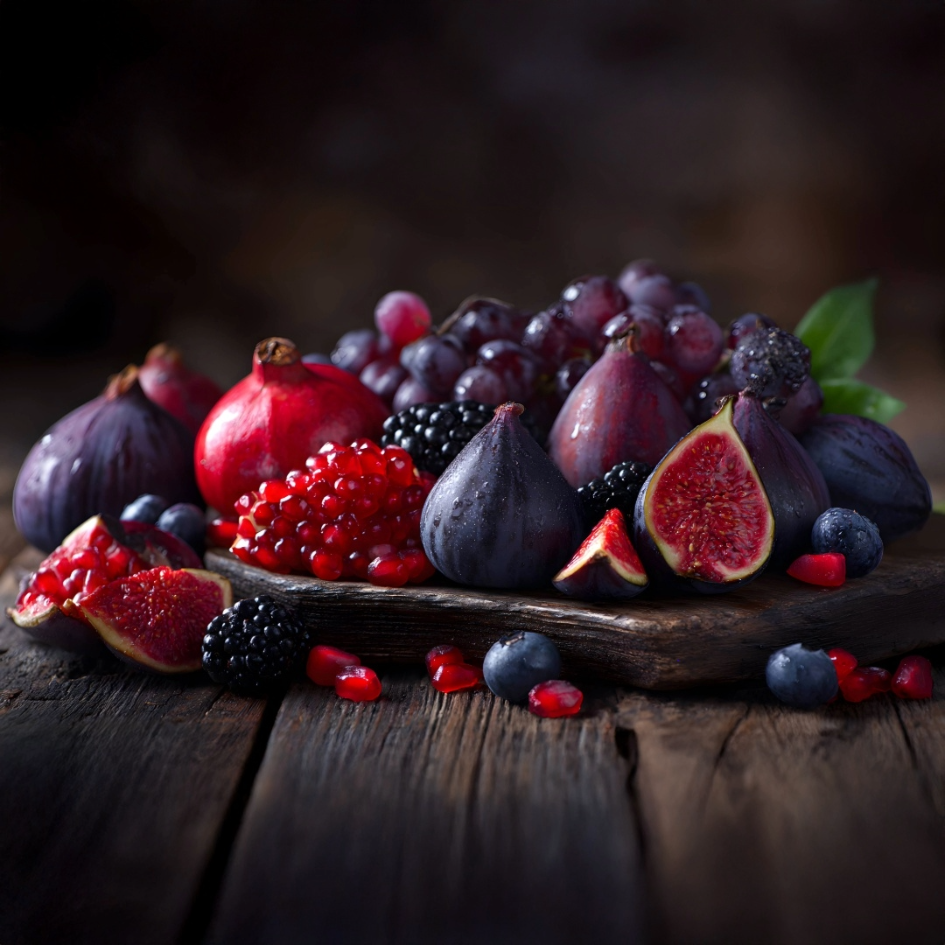
Pronounced an-tho-sigh-an-ins (from the Greek anthos, meaning flower, and kyanos, meaning dark blue), anthocyanins are naturally occurring plant pigments that give many fruits and vegetables their deep purple, blue and red colours. Think red cabbage, blackberries, blackcurrants and haskap berries.
They belong to a wider family of plant compounds known as polyphenols, specifically a subgroup called flavonoids, which are widely studied in nutrition science.
What are flavonoids?
Flavonoids are the largest group of polyphenols and are commonly discussed in research exploring diet and long-term health. They are often associated with colourful plant foods, which is why nutrition advice frequently encourages people to “eat the rainbow.” Each colour in fruit and vegetables reflects a different mix of naturally occurring compounds, offering dietary variety and nutritional interest.
Anthocyanins are one of the most researched flavonoids. Scientific studies continue to explore their relationship with areas such as cardiovascular markers, cognitive function, inflammation and aspects of healthy ageing in different populations. In large observational studies, anthocyanin intake has been associated with:
Difference in cognitive ageing
Cardiovascular outcomes
Metabolic health markers
These types of studies look at dietary patterns across groups of people rather than proving cause and effect in individuals.

The haskap berry
Haskap berries are notable for their naturally high anthocyanin content — in some analyses containing substantially more than blueberries.
They also have a distinctive anthocyanin profile, with one compound in particular, cyanidin-3 glucoside (often referred to as C3G), accounting for a large proportion of the total anthocyanins found in the fruit.
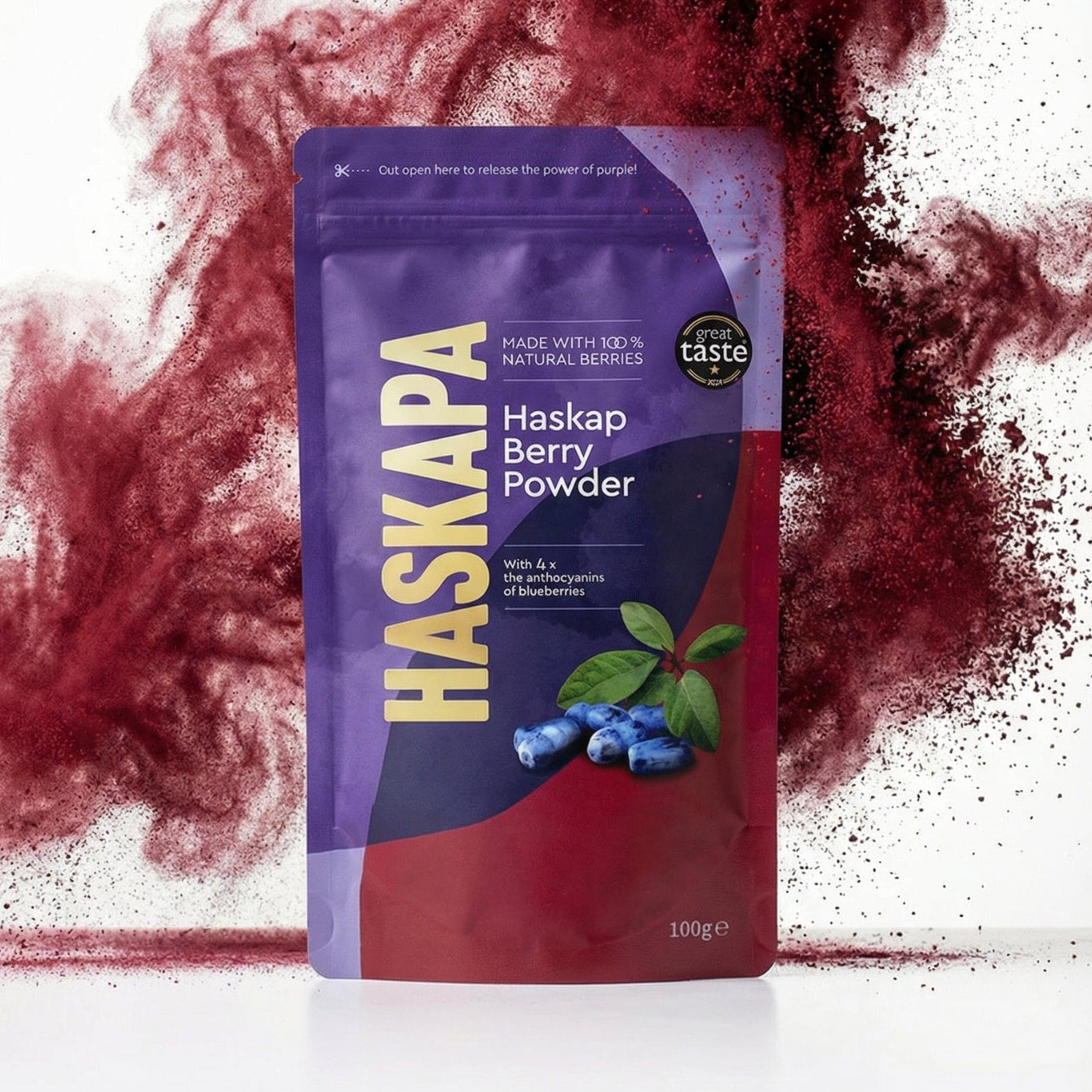
Because Haskapa is made from freeze-dried whole haskap berries, these pigments are concentrated into a fine powder that retains the berry’s deep colour and polyphenol content. Just one teaspoon can provide an anthocyanin intake comparable to a generous handful of fresh purple berries, in a convenient form that can be stirred into breakfast in seconds.
Our product collection
-

Haskapa Superfood Berry Powder
shop powderAn easy-to-use powder with a naturally concentrated berry profile, blending easily into yoghurt, porridge, and smoothies.
-

Haskapa Organic Superfood Berry Powder
Shop organic powderOrganic version of our signature pure berry powder. This organic freeze-dried haskap berry powder is made with the whole berry and nothing else added.
-

The Haskapa Storage Jar
shop haskapa jarCrafted from unique violet-tinted glass, this jar is more than just stylish. Its special design blocks out harmful light and moisture, keeping your berry powder fresh and protected.


What are antioxidants?
Antioxidants in food are naturally occurring compounds found in certain plants. They are widely discussed in relation to oxidative processes that happen naturally in the body as part of everyday metabolism.
Oxidative stress is the term used when there is an imbalance between free radicals and the body’s antioxidant defences, and it is an active area of research in relation to long-term health. Nutrition scientists continue to investigate how dietary antioxidants contribute to overall dietary patterns and wellbeing.
Anthocyanins are one type of antioxidant, and researchers study how they behave in the body and how they may interact with biological systems.
In laboratory testing, haskap berries have been found to show high antioxidant capacity compared with many other berries, though exact comparisons depend on factors such as variety, growing conditions, ripeness at harvest and the testing methods used.
How Haskapa makes anthocyanins easy
Adding Haskapa Berry Powder to your routine is a simple way to include anthocyanin-rich foods in your diet, without overhauling what you already eat.
A small everyday addition: Stir a spoon of Haskapa into yoghurt, porridge, overnight oats or a smoothie to bring natural colour and plant compounds into your breakfast.
Purple foods, year-round: Fresh berries are seasonal and perishable, but freeze-drying allows their naturally occurring pigments and polyphenols to be retained in a stable, convenient format.
Real food, not a synthetic pill: We focus on whole berries rather than isolated extracts, reflecting a food-first approach to nutrition that values the natural mix of fibre, vitamin C and plant compounds found in fruit.

Bringing the science into your own kitchen
Imagine turning yoghurt purple or giving your green smoothie a berry-rich twist with a scoop of Haskapa — a vivid sign you’ve added anthocyanin-rich fruit to your day.
Whether you’re interested in heart-healthy eating patterns, brain-supportive nutrition, post-exercise routines or simply adding more colourful plant foods to a busy lifestyle, Haskapa offers a practical, great tasting way to include these distinctive berries in everyday meals.
Learn More
-
Learn More
HEALTHY AGEING & METABOLIC HEALTH
-
Learn More
INFLAMMATION & GUT HEALTH
-
Learn More
COGNITIVE FUNCTION & MEMORY
-
Learn More
BLOOD PRESSURE & HEART HEALTH
-
Learn More
NUTRITION & ACTIVE LIFESTYLES

References
Click here to view references
1. Gołba M, Sokół-Łętowska A, Kucharska
AZ. Health properties and composition of honey- suckle berry Lonicera caerulea
L. An update on recent studies. Molecules. 2020;25(3):749.
2. Shimoyama Y, editor. The hascup – An introduction. Hokkaido
Government, IBURI Subprefectural Office, Department of Industrial Promotion,
Agricultural Affairs Division; 2008. Available from: http://www.iburi.pref.hokkaido.lg.jp/ss/num/hasukappu.htm
3. Thompson MM. Introducing haskap, Japanese blue honeysuckle. J
Am Pomol Soc. 2006;60(4):164–8.
4. Rupasinghe HPV, Arumuggam N, Amararathna M, De Silva ABKH.
The potential health benefits of haskap (Lonicera caerulea L.): Role of
cyanidin-3-O-glucoside. J Funct Foods. 2018;44:24–39.
5. De Silva ABKH, Rupasinghe HPV. Polyphenols composition and
antidiabetic properties in vitro of haskap (Lonicera caerulea L.) berries in
relation to cultivar and harvesting date. J Food Compos Anal. 2020;88:103402.
6. Igwe E, Charlton K, Probst Y. Usual dietary anthocyanin
intake, sources and their association with blood pressure in a representative
sample of Australian adults. J Hum Nutr Diet. 2019;32:10.1111/jhn.12647.
7. Kalt W, Cassidy A, Howard LR, Krikorian R, Stull AJ, Tremblay
F, Zamora-Ros R. Recent research on the health benefits of blueberries and
their anthocyanins. Adv Nutr. 2019 Jul 22;nmz065. https://doi.org/10.1093/advances/nmz065
8. Cassidy A, Mukamal KJ, Liu L, Franz M, Eliassen AH, Rimm EB.
High anthocyanin intake is associated with a reduced risk of myocardial
infarction in young and middle-aged women. Circulation. 2013;127(2):188–96.
9. Cassidy A, Bertoia M, Chiuve S, Flint A, Forman J, Rimm EB.
Habitual intake of anthocyanins and flavanones and risk of cardiovascular
disease in men. Am J Clin Nutr. 2016;104:587–94.
10. Cassidy A, O’Reilly ÉJ, Kay C, Sampson L, Franz M, Forman
JP, et al. Habitual intake of flavonoid subclasses and incident hypertension in
adults. Am J Clin Nutr. 2011;93(2):338– 47.
11. Devore EE, Kang JH, Breteler MM, Grodstein F. Dietary
intakes of berries and flavonoids in relation to cognitive decline. Ann Neurol.
2012;72(1):135–43.
12. Ahles S, Joris PJ, Plat J. Effects of berry anthocyanins on
cognitive performance, vascular function and cardiometabolic risk markers: A
systematic review of randomized placebo- controlled intervention studies in
humans. Int J Mol Sci. 2021;22(12):6482.
13. Jacques PF, Au R, Blumberg JB, Rogers GT, Shishtar E.
Long-term dietary flavonoid intake and risk of Alzheimer’s disease and related
dementias in the Framingham Offspring Cohort. Am J Clin Nutr. 2020.
doi:10.1093/ajcn/nqaa079.
14. Biswas D, Sarkar S, De Silva ABKH, D’Souza K, Kienesberger
P, Rupasinghe HPV, Pulinilkunnil T. Cyanidin-3-O-glucoside rich extract from
haskap berry improves glucose homeostasis and insulin sensitivity in
diet-induced obese mice. Can J Diabetes. 2018;42(5):S55.
doi:10.1016/j.jcjd.2018.08.16.
15. Bell L, Williams CM. A pilot dose–response study of the
acute effects of haskap berry extract (Lonicera caerulea L.) on cognition,
mood, and blood pressure in older adults. Eur J Nutr. 2018.
doi:10.1007/s00394-018-1877-9. https://doi.org/10.1007/s00394-018-1877-9
16. Howatson G, Snaith GC, Kimble R, Cowper G, Keane KM.
Improved endurance running performance following haskap berry (Lonicera
caerulea L.) ingestion. Nutrients. 2022;14(4):780. doi:10.3390/nu14040780. https://www.haskapa.com/pages/haskapa-and-sports-research