



What do we mean by heart health?
Heart health refers to the overall wellbeing of the heart and blood vessels throughout life. The heart works continuously to circulate blood around the body, delivering oxygen and nutrients to tissues and organs as part of normal, everyday function.
Like all systems in the body, the heart is influenced by a wide range of factors over time. Age, genetics, environment, and daily habits all play a role in shaping long-term cardiovascular wellbeing.
Heart health is not static — it evolves across the lifespan. From early adulthood through later life, the heart responds to changing demands, routines, and lifestyle patterns.
Rather than being defined by a single moment or milestone, heart health reflects the cumulative effect of everyday choices made
over many years.
The Importance of lifestyle for heart health
Lifestyle plays a central role in shaping heart health over time. Habits related to
movement, food choices, sleep, and stress all influence the body’s internal
environment on a day-to-day basis.
Modern life can place new demands on the body, making consistency and balance increasingly important. Regular physical activity, a varied diet built around whole foods, adequate rest, and time to recover from stress are widely recognised as key components of a heart-conscious lifestyle.

Dietary patterns and heart health: what’s being explored
Food choices are a central part of everyday life, and over time they contribute to broader dietary patterns. Much of the current conversation around heart health focuses not on individual foods, but on the way foods are combined and eaten consistently over many years.
Research into dietary patterns commonly explores ways of eating that emphasise a wide range of plant foods — vegetables, fruits, wholegrains, legumes, nuts, and seeds — alongside sources of healthy fats like olive oil, avocados, and oily fish. These patterns are typically built around foods that are closer to their natural form, with an emphasis on variety, balance, and minimal processing.
Rather than focusing on restriction, these approaches celebrate flavour, colour, and flexibility — encouraging meals made from whole ingredients that nourish the body and fit seamlessly into everyday life.
Within these plant-forward, minimally processed food choices, fruits and berries play a natural role in adding colour, flavour, and variety to everyday meals.
Fruits, berries, and the power of colour
Fruits and berries are widely recognised for the colour, flavour, and freshness they bring to everyday meals. Within plant-based eating patterns, they are often valued for their versatility — enjoyed fresh, blended, baked, or added to both sweet and savoury dishes.
Berries, in particular, are notable for their intense natural colours. These colours come from pigments such as anthocyanins, which are part of a broader group of plant compounds known as polyphenols. Deeply pigmented berries tend to contain higher concentrations of these naturally occurring compounds, giving them their characteristic appearance.
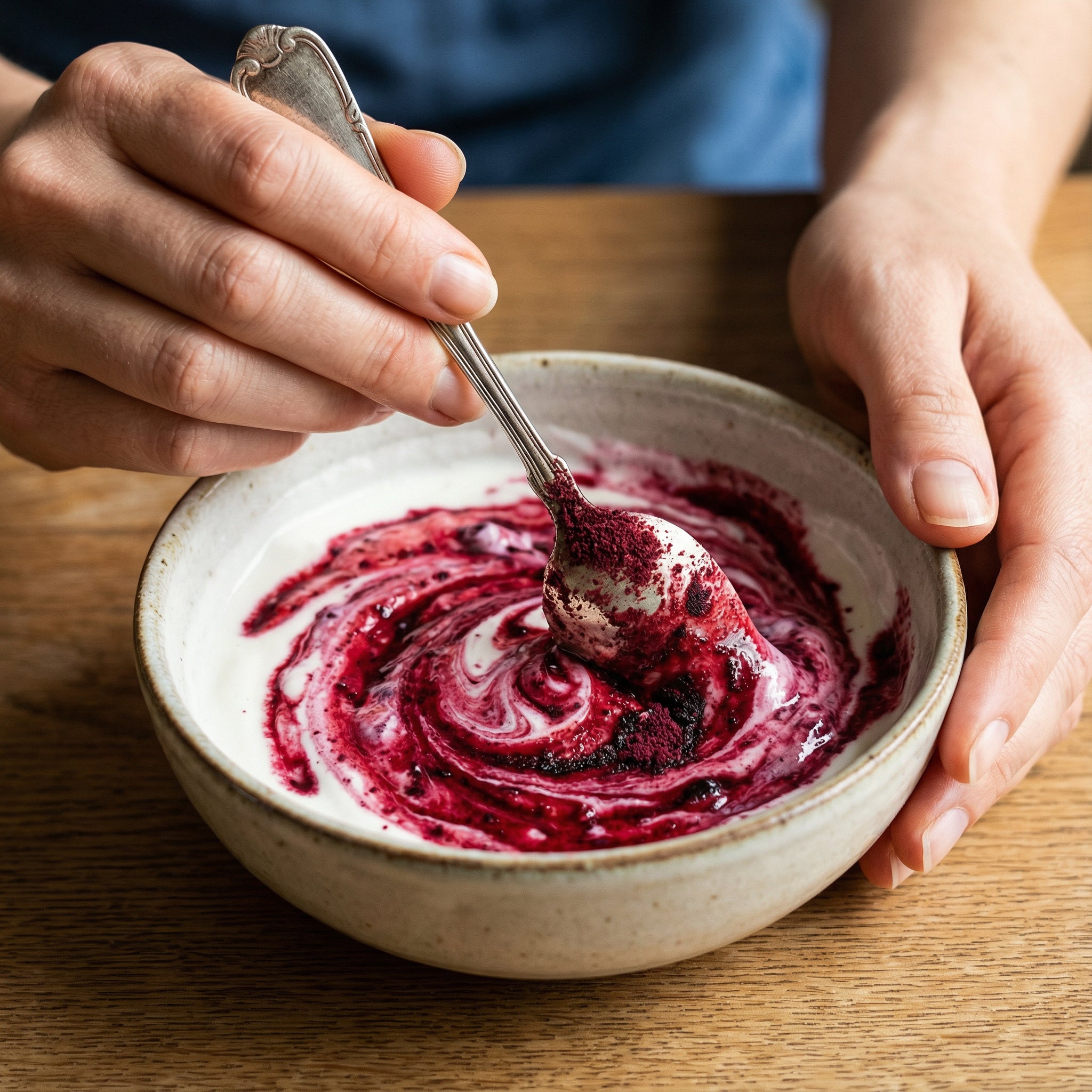
Haskap: a distinctively dark berry
Among deeply pigmented berries, haskap berries stand out for their exceptionally dark purple skin and rich colour. Traditionally grown in colder climates, the berry has a distinctive flavour profile and a naturally high concentration of anthocyanins, alongside a diverse range of polyphenols.
How much anthocyanin do you need?
Although there is still no agreed daily intake value for anthocyanins, a recent review paper recommended that we eat 50mg anthocyanins per day for optimal benefit. Most people in northern European counties, including the UK consume much lower amounts. So, taking just one to two teaspoons of Haskap Berry Powder, each day will give you your daily anthocyanin boost.

Emerging research on haskap
Emerging research is beginning to explore how anthocyanin-rich foods like haskap berry powder may fit within broader approaches to heart conscious eating. In a controlled intervention study in healthy older adults, volunteers consumed a preparation of haskap berry extract standardised to provide between 100mg-400mg of anthocyanins. Compared with a placebo condition, the highest anthocyanin dose was associated with lower diastolic blood pressure and reduced heart rate measured about 90 minutes after consumption
Haskap berries are naturally rich in anthocyanins such as cyanidin-3-O glucoside, with concentrations that compare favourably to many other deeply pigmented fruits. While this research is still in its early stages and focused on short-term outcomes under controlled conditions, it adds to scientific interest in how polyphenol rich berries may complement a varied, plant-based eating pattern that supports overall cardiovascular wellbeing.
It’s worth noting that this was a relatively small, short-term clinical trial designed to explore immediate responses under controlled conditions. Haskapa has further heart health study underway for 2026 investigating how anthocyanin-rich foods may contribute to health when consumed regularly as part of everyday diets.

Berries as part of a plant-based lifestyle
Berries bring colour, flavour, and creativity to plant-based eating, whether enjoyed fresh, frozen, or in powdered form. They can be stirred into breakfast bowls, blended into smoothies, or folded into yoghurt and simple bakes, adding depth and vibrancy to everyday recipes. Berry powders offer a convenient way to include berries year-round, easily mixed into drinks, dressings, or sprinkled over meals, making them a flexible ingredient alongside other plant foods such as grains, nuts, seeds, and vegetables
Our product collection
-

Haskapa Superfood Berry Powder
shop powderAn easy-to-use powder with a naturally concentrated berry profile, blending easily into yoghurt, porridge, and smoothies.
-

Haskapa Organic Superfood Berry Powder
Shop organic powderOrganic version of our signature pure berry powder. This organic freeze-dried haskap berry powder is made with the whole berry and nothing else added.
-

The Haskapa Storage Jar
shop haskapa jarCrafted from unique violet-tinted glass, this jar is more than just stylish. Its special design blocks out harmful light and moisture, keeping your berry powder fresh and protected.


Top tips & takeways
-
Prioritise heart-friendly habits early
Lifestyle changes such as eating more plant foods, moving daily, managing stress and avoiding smoking are widely encouraged as part of a balanced, long-term approach to health.
-
Berries are nutrient-dense
Berries provide fibre, vitamins and naturally occurring plant compounds, making them a flavourful addition to a varied, balanced diet.
-
Include anthocyanin-rich foods regularly
Deeply coloured berries such as haskap provide naturally occurring anthocyanins and can be enjoyed as part of a varied diet that includes a wide range of plant foods.
-
Make colour your cue
Richly coloured fruits and vegetables — especially deep purples, blues and reds — contain anthocyanins, the plant compounds responsible for their vibrant hues. Choosing a variety of colourful produce is a simple way to bring greater plant diversity to your diet.
-
Haskap stands out for colour intensity
Haskap berries are known for their deep blue-purple colour and naturally high anthocyanin content compared with many other commonly consumed berries.
-
Think long-term
No single food is a magic fix. A balanced diet, regular physical activity, good sleep and effective stress management all play a role in long-term health. Including a variety of colourful plant foods can be part of this broader lifestyle approach.


Why should berries feature regularly in our diets?
"One of the most striking things about berries is their colour. The deep reds, blues, purples and almost-black tones seen in strawberries, blackberries, blackcurrants, raspberries — and especially haskap berries — reflect the presence of naturally occurring plant compounds called polyphenols, which the berry produces for its own protection and which we benefit from when we eat them.
Within this broad family, berries are particularly known for their flavonoid content — and specifically anthocyanins, the pigments responsible for those intense blue and purple hues. Interest in flavonoid-rich foods has grown considerably in nutrition research, particularly within dietary patterns that emphasise plant diversity and minimally processed ingredients.
Including berries such as haskap as part of a varied, balanced diet is a simple way to bring both colour and plant variety to everyday meals."
Julie Weston. Lead Nutritionist, Haskapa
Learn More
-
Learn More
HEALTHY AGEING & METABOLIC HEALTH
-
Learn More
INFLAMMATION & GUT HEALTH
-
Learn More
COGNITIVE FUNCTION & MEMORY
-
Learn More
BLOOD PRESSURE & HEART HEALTH
-
Learn More
NUTRITION & ACTIVE LIFESTYLES

References
Click here to view references
Intensive lifestyle changes for reversal of
coronary heart disease (1999) D Ornish, L W
Scherwitz, J H
Billings, S E
Brown, K L
Gould, T A
Merritt, S
Sparler, W T
Armstrong, T A
Ports, R L
Kirkeeide, C
Hogeboom, R J
Brand. The
Journal of the American Medical Association, 281(15):1380 https://pubmed.ncbi.nlm.nih.gov/9863851/
·
Lifestyle Improvement
and the Reduced Risk of Cardiovascular Disease: The China-PAR Project (2023)
JIANG, Ying-Ying, et al. Journal of Geriatric Cardiology, 20(11) 779-787. https://pmc.ncbi.nlm.nih.gov/articles/PMC10716616/
·
Effect of Lifestyle
Intervention on Metabolic Coronary Heart Disease Risk Factors in Obese Older
Adults (2006) Villareal, Dennis T, et al. The American Journal of Clinical Nutrition, vol. 84 (6) https://doi.org/10.1093/ajcn/84.6.1317.
- High anthocyanin intake is associated
with a reduced risk of myocardial infarction in young and middle-aged
women. Cassidy A, Mukamal KJ, Liu L, Franz M, Eliassen AH, Rimm EB.
Circulation. 2013 Jan 15;127(2):188-96 - Habitual intake of anthocyanins and flavanones
and risk of cardiovascular disease in men. Cassidy A, Bertoia M, Chiuve S,
Flint A, Forman J, Rimm EB. Am J Clin Nutr 2016;104:587–94. - Habitual intake of flavonoid subclasses
and incident hypertension in adults. Cassidy A, O’Reilly ÉJ, Kay C,
Sampson L, Franz M, Forman JP, Curhan G, Rimm EB.Am J Clin Nutr. 2011
Feb;93(2):338-47. - Circulating Anthocyanin Metabolites
Mediate Vascular Benefits of Blueberries: Insights From Randomized
Controlled Trials, Metabolomics, and Nutrigenomics. Ana
Rodriguez-Mateos, Geoffrey Istas, Lisa Boschek, Rodrigo P
Feliciano, Charlotte E Mills, Céline Boby, Sergio Gomez-Alonso,
Dragan Milenkovic, Christian Heiss, The Journals of
Gerontology: Series A, Volume 74, Issue 7, July 2019, Pages 967–976, https://doi.org/10.1093/gerona/glz047 - Effects of Berry Anthocyanins on
Cognitive Performance, Vascular Function and Cardiometabolic Risk Markers:
A Systematic Review of Randomized Placebo-Controlled Intervention Studies
in Humans (2021) Int J Mol Sci. Ahles S, Joris PJ, Plat J. 1 Jun
17;22(12):6482. doi: 10.3390/ijms22126482. PMID: 34204250; PMCID:
PMC8234025. - A pilot dose–response study of the acute
effects of haskap berry extract (Lonicera caerulea) on cognition,
mood, and blood pressure in older adults. Bell, L. & Williams,
C.M. Eur JNutr (2018). https://doi.org/10.1007/s00394-018-1877-9 - Recent research on the health benefits of
blueberries and their anthocyanins. Wilhelmina Kalt, Aedin
Cassidy, Luke R Howard, Robert Krikorian, April J
Stull, Francois Tremblay, Raul Zamora-Ros. Advances in Nutrition,
nmz065, https://doi.org/10.1093/advances/nmz065 (Published: 22 July 2019) - Igwe, Ezinne & Charlton, Karen &
Probst, Yasmine. (2019). Usual dietary anthocyanin intake, sources and
their association with blood pressure in a representative sample of
Australian adults. Journal of Human Nutrition and Dietetics. 32.
10.1111/jhn.12647. - Dietary Flavonoid and Lignan Intake and
Mortality in Prospective Cohort Studies: Systematic Review and
Dose-Response Meta-Analysis. Grosso, Agnieszka Micek, Justyna Godos,
Andrzej Pajak, Salvatore Sciacca, Fabio Galvano, Edward L.
Giovannucci.American Journal of Epidemiology, Volume 185, Issue 12, 15
June 2017, Pages 1304–1316, https://doi.org/10.1093/aje/kww207 - Thompson, M. M. (2006). Introducing
haskap, Japanese blue honeysuckle. Journal of the American Pomological
Society, 60(4), 164–168